2026-07-24
Pull-through sharpeners are the most popular sharpening tool in Singaporean kitchens. They are cheap, small, and easy to use: drag the knife through the slot a few times and it feels sharp again.
So are they ruining your knives? The honest answer is: it depends on the sharpener, the knife, and how often you use it. Some are fine for occasional touch-ups. Others take off steel quickly and leave a rough edge that dulls fast.
Here is how to tell which situation you are in.
Most pull-through sharpeners have two abrasive surfaces set in a V shape. As you pull the knife through, both sides of the edge are ground at once, at an angle fixed by the slot.
There are three common types:
They are convenient because they remove the hardest part of sharpening, which is holding a steady angle.
They scrape steel rather than refine it. Carbide slots in particular tear steel off the edge. The knife feels sharp right away, but the edge is ragged and weak, so it dulls again within days.
They remove more metal than necessary. Many people pull the knife through "a few extra times to be safe." Over months, this wears the blade down visibly, especially near the heel.
The angle may not match your knife. Most units are set for Western knives at roughly 20 degrees per side. Many Japanese knives are sharpened closer to 15 degrees. Forcing a thin Japanese blade through a Western slot can blunt its geometry and sometimes chip the edge.
They leave a recess near the heel. Because the heel cannot sit in the slot the way the rest of the blade does, repeated use often wears a dip just in front of it. The edge then stops touching the board in that spot, and the knife "misses" when you chop.
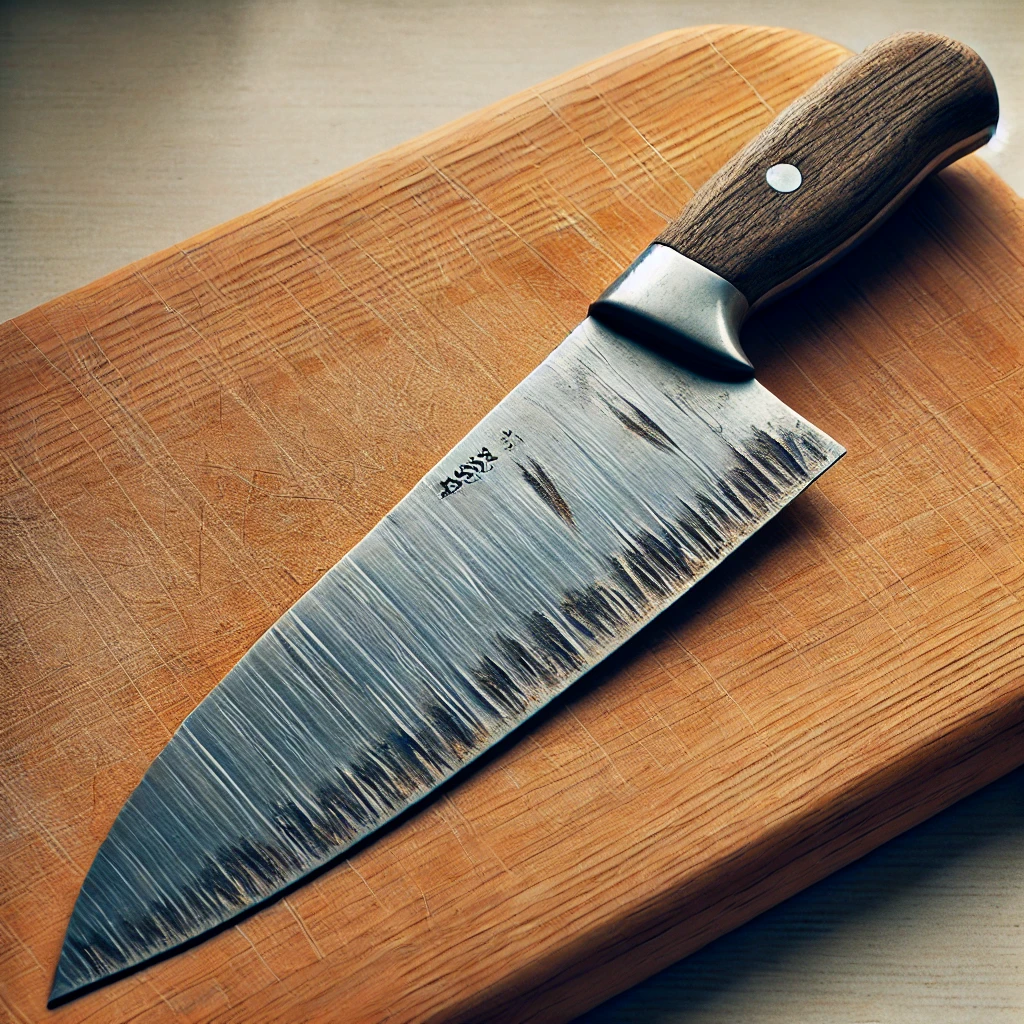 A knife can feel sharp after a pull-through and still have a ragged, uneven edge.
For these, a whetstone or professional sharpening is the safer route. See our guide on Japanese vs Western sharpening methods to learn why.
There is a time and place for them. A pull-through can be reasonable when:
Used this way, it is closer to a quick touch-up than true sharpening.
If you do use one, these habits make a big difference:
Check your knife for:
Most of this can be corrected by reprofiling, which means resetting the edge so it is straight and even again. The longer it goes on, the more steel has to come off to fix it.
Pull-through sharpeners are not evil, but they are often overused. Treat them as an occasional touch-up for inexpensive knives, not as a replacement for real sharpening. Keep your good knives well away from them.
If your knife always feels dull a few days after you "sharpen" it, the problem may be the sharpener, not the knife.
P.s. Think a pull-through sharpener has worn down your knife? Our knife sharpening service can reprofile the edge and remove the heel dip, with pickup and delivery across Singapore.
We are currently only operating in Singapore. Our next pick up will be on .