2026-05-29
People often talk about sharpness as if it has only one ideal form. In real kitchens, the best edge depends on what the knife is supposed to cut. A highly polished edge can be beautiful and precise, but a toothy edge can outperform it on many everyday foods.
The question is not "which edge is sharper?" The better question is "which edge is right for this knife and this job?"
A toothy edge has microscopic bite. Under magnification, it is not perfectly smooth. It has tiny peaks and scratches left by the abrasive. Those micro-teeth help the knife grip food surfaces and start cuts quickly.
This is useful for tomato skin, capsicum skin, crusty bread, fibrous vegetables, and cooked meats with a firmer exterior.
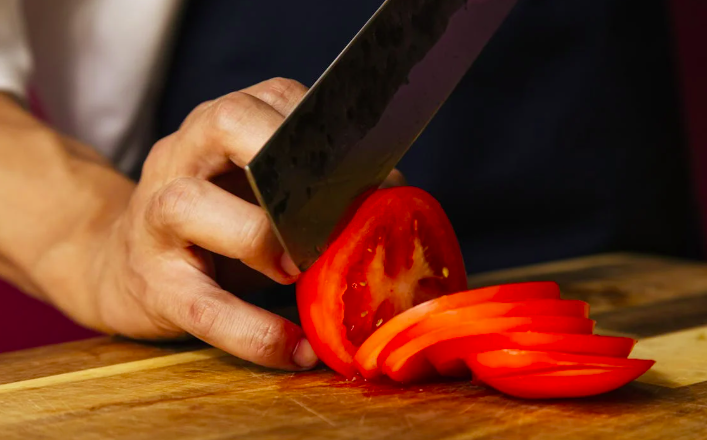 Tomatoes often favour an edge with enough bite to start the cut cleanly.
A polished edge is refined with finer abrasives until the scratch pattern is much smaller and smoother. It can feel extremely clean through soft proteins and delicate slicing tasks.
Polished edges are often appreciated on slicers, certain Japanese knives, and knives used for fish or cooked meats where a clean surface matters.
It is tempting to assume that finer always means better. But for an everyday chef knife, too much polish can reduce bite. The knife may still be sharp, but it can skate slightly on tomato skin or struggle to initiate cuts on waxy vegetables.
This is why a knife can pass a paper test but feel strangely hesitant on food. Paper is a useful test, but food is the real test.
For general home cooking, a moderate tooth is often ideal. It gives enough bite for vegetables while still feeling smooth in most cuts.
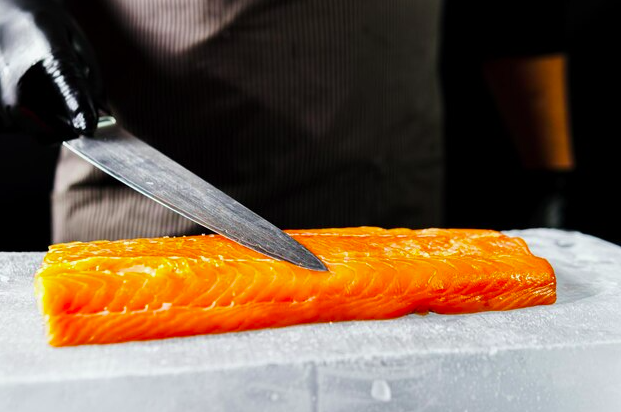 Delicate protein slicing can benefit from a more refined edge.
Steel matters. Some steels take and hold a toothy edge beautifully. Others respond well to higher polish. Hard, fine-grained steels can often support more refinement, while tougher workhorse steels may be better with a practical, mid-grit finish.
This does not mean one steel is better than another. It means sharpening should respect the material.
If you use a slicing motion, a toothy edge can feel lively because the micro-teeth engage as the blade moves. If you rely on straight push cuts, a polished edge may feel cleaner.
This is one reason two cooks can prefer different finishes on the same knife. Technique changes what the edge is asked to do.
Even a polished edge becomes more toothy as it wears. Even a toothy edge loses bite as the peaks round over. Cutting boards, food acids, cleaning habits, and storage all affect how long the finish lasts.
If your knife still feels sharp but no longer starts cuts cleanly, it may need a refreshed finish rather than major repair.
For a main chef knife or santoku, choose a balanced finish: refined enough to cut smoothly, toothy enough to bite into tomatoes and onions. For a slicer used mostly on fish or cooked proteins, go more polished. For a utility knife or serration-like bite without actual serrations, keep more tooth.
The best sharpening services do not force every knife to the same finish. They choose based on the blade and its use.
Toothy and polished edges are both useful. The expert move is knowing when each one belongs. A great everyday knife should not only feel sharp in a test. It should match the food you cook, the way you cut, and the steel it is made from.
For more on real-world cutting performance, read why your knife feels sharp but doesn't cut well.
P.s. If you want your knife sharpened for how you actually cook, our knife sharpening service can match the edge finish to the blade and its job.
We are currently only operating in Singapore. Our next pick up will be on .