2026-08-07
Walk into almost any Singaporean home kitchen and you'll find one: a broad, rectangular cleaver, often older than the people using it. Many younger cooks treat it as a relic and reach for a chef knife instead.
That's a mistake. A good Chinese cleaver may be the most versatile knife in the kitchen. It slices, chops, smashes, and scoops. But there's one big catch: not all cleavers are the same, and using the wrong one is a quick way to ruin it.
Vegetable cleaver (cai dao / 菜刀). Thin blade, fairly light, very sharp. Despite the name, it is an all-purpose kitchen knife. It handles vegetables, boneless meat, fish, garlic, and ginger. It is not for bones.
Bone cleaver (chopper / 骨刀). Much thicker and heavier, with a blunter edge angle. It's built for chicken bones, pork ribs, and duck. It is too heavy and too thick for fine slicing.
The most common cleaver mistake in Singapore is using a thin vegetable cleaver to chop through chicken bones. The edge chips, sometimes badly. If you look at your cleaver and see a row of small notches, that's probably what happened.
A quick way to tell: look at the spine. If it's thin, a few millimetres at most, it's a vegetable cleaver. If it's thick and the knife feels heavy in your hand, it's a bone chopper.
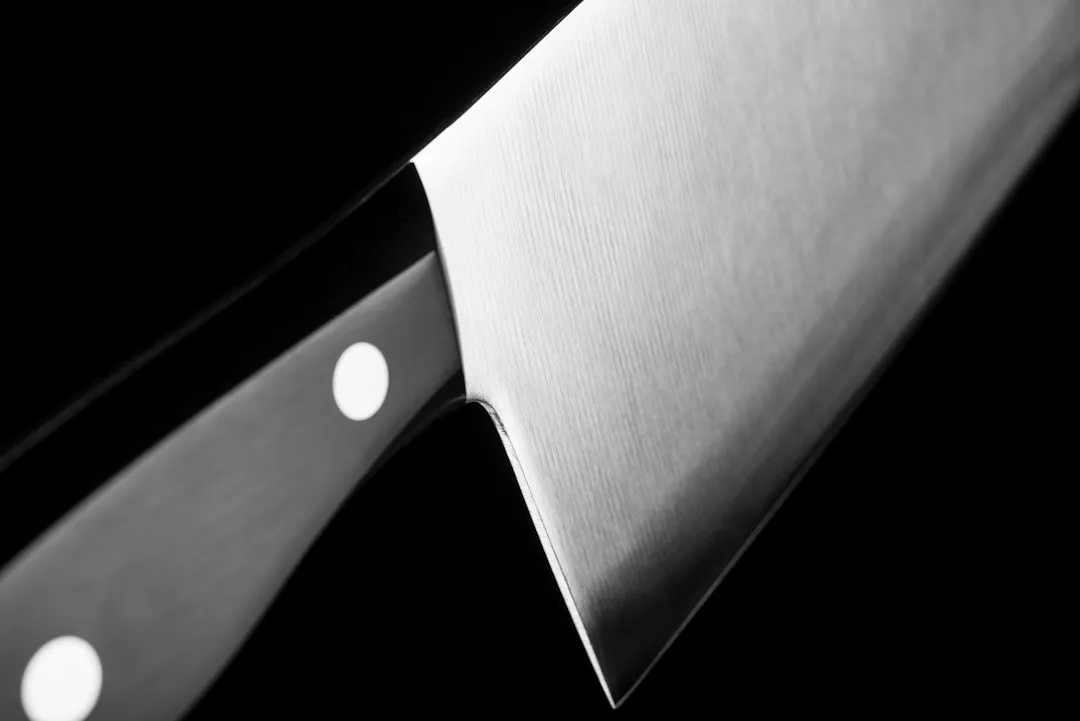 Check the spine: a thin spine means a vegetable cleaver, a thick one means a bone chopper.
Transferring food. The wide blade works as a scoop. Chop, flip the cleaver flat, slide it under the food, and carry it to the wok.
Smashing garlic and ginger. Lay the flat of the blade on a clove and press down with your palm. Use the flat only, never the edge.
Push cutting. A cleaver's flat edge suits straight push and pull cuts through vegetables. This is the classic Chinese knife technique and it is fast once you learn it.
Thin, even slices. The tall blade gives your knuckles a large guide surface, which makes consistent slicing easier.
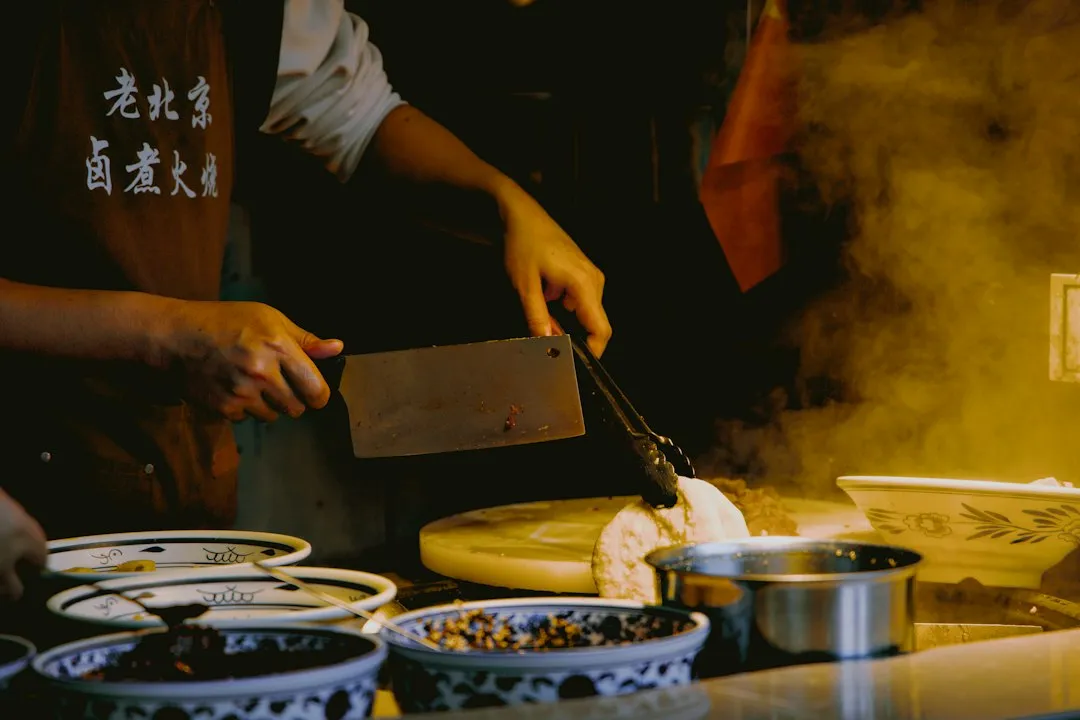 In many Chinese kitchens, the cleaver does almost every job.
Use a pinch grip: your thumb and index finger pinch the blade just in front of the handle, and your other fingers wrap the handle. This gives you much more control than holding the handle alone.
Keep your guiding hand in a "claw" shape, with your fingertips tucked in and your knuckles against the side of the blade. The tall blade makes this grip feel natural.
For more technique basics, see the best knife techniques every home cook should learn.
Many older cleavers, especially those passed down, are made from carbon steel. They take a very keen edge and are easy to sharpen, but they rust quickly in Singapore's humidity.
Our guide to carbon steel knives in Singapore covers this in detail.
Cleavers can be sharpened like any other knife, but they have quirks:
Most cleaver edges can be restored, even old, rusty, chipped ones. A family cleaver that has been sitting in the drawer for years is often worth reviving rather than replacing.
The cleaver isn't old-fashioned. It's a fast, versatile, and very practical knife that suits the way many Singaporeans cook. Just use the right kind for the job: the thin one for slicing, the thick one for bones.
If there's an old cleaver in your kitchen that nobody uses anymore, it may only need a good sharpening to become the knife you reach for every day.
P.s. Got a chipped or rusty family cleaver? Our knife sharpening service can de-rust it, repair chips, and bring back the edge, with pickup and delivery across Singapore.
We are currently only operating in Singapore. Our next pick up will be on .